

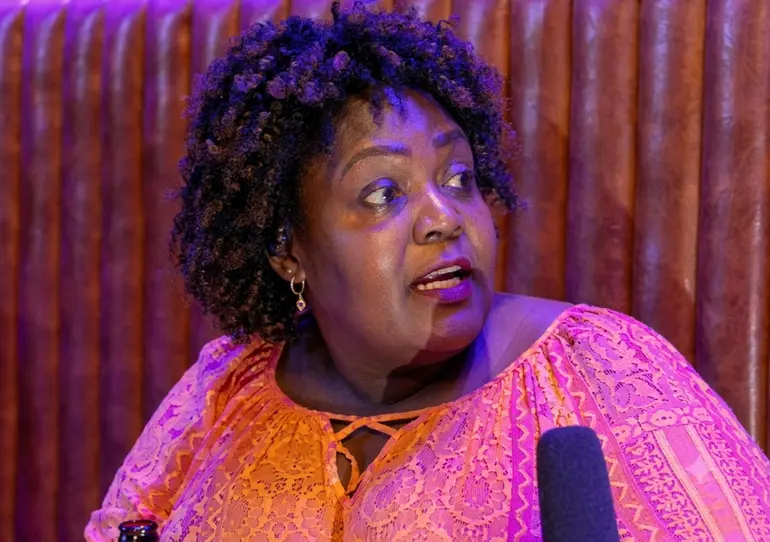
For years, questions lingered around Paul Kafeero’s personal life — his marriages, his children, and the woman who stood closest to him at the end.
Now, Robinah Namatovu Bisirikirwa, the singer’s widow, is speaking openly about all of it. In a recent interview, she described a love story built on devotion, tested by illness, and defined by a choice she made to stay when leaving would have been easier.
Her account covers the medical diagnosis that changed everything, the children Kafeero acknowledged in his lifetime, and what she says the DNA tests have since confirmed.
Bisirikirwa said that the question of children was not one of unwillingness — it was one of reality.
After the couple underwent medical tests together, the results revealed that Kafeero was unwell while she was in good health. Doctors also informed them that he had a low sperm count, a condition attributed to excessive alcohol consumption.

In her own words:
“When we underwent medical tests, we discovered that Kafeero was sick while I was fine. From that moment, we understood that having children would not be possible. I thanked God for giving me the strength to stay by his side instead of abandoning him when he was at his weakest.”
She continued: “I remained with him and took care of him until his final days. Doctors also confirmed that he could no longer father children because he had a low sperm count caused by excessive drinking.”
The candour of that account is striking. Bisirikirwa does not frame it as tragedy alone — she frames it as a decision, a conscious choice to honour the man she loved through his most vulnerable period.
On the matter of Kafeero’s children, she was equally direct. She stated that the only children the singer acknowledged during his lifetime are the same ones confirmed by recent DNA testing — children he fathered when he was young, before the illness progressed.

“They are the same children who were confirmed by the DNA tests because he brought them home while we were living together,” she said, adding that she personally cared for them — bathing them and raising them as part of their shared home.
She also addressed the broader narrative around Kafeero’s romantic history. Bisirikirwa said she was the only woman Kafeero formally pursued — that he courted her for close to a year and a half before she agreed to the relationship. She drew a firm distinction between herself and other women connected to his name, saying the others came into his life through his performance circuit rather than through any deliberate pursuit on his part.
“I am the only woman Paul Kafeero officially married; the others were simply women he had relationships with,” she said.
Paul Job Kafeero was one of Uganda’s most beloved musicians — a singer whose work embedded itself into the cultural and emotional fabric of the country. His voice carried a particular kind of sorrow and sincerity that audiences across generations connected with deeply.

His death left behind not just a musical legacy but also unresolved questions about his personal life, including the matter of his children and the women he was associated with. The DNA testing referenced by Bisirikirwa appears to have been part of a broader effort to establish clarity around his lineage — a process that has played out publicly in the time since his passing.

Bisirikirwa’s willingness to now speak in detail about their relationship adds a personal dimension to a story that had, until recently, been told largely through speculation and secondhand accounts.
Paul Kafeero belongs to a category of Ugandan artists whose personal lives carry public weight precisely because their music was so intimate. Songs that spoke to love, loss, and longing make listeners feel entitled to know the man behind them.
Bisirikirwa’s interview does something important — it puts a human face on a story that had been reduced to rumour. Her account of staying through illness, of raising children that were not biologically hers, and of quietly holding a marriage together while the world speculated, is not a tabloid moment. It is a portrait of loyalty under pressure.
For fans of Kafeero, it also provides something they may not have expected: answers, delivered calmly and directly by the person who was there.
There is something quietly powerful about the way Bisirikirwa tells this story.

She does not position herself as a victim. She does not perform grief. She speaks about the medical diagnosis, the decision to stay, and the years of caregiving as though they were simply what love required of her — not what love cost her.
That kind of composure, in a story this personal, is its own statement.
Paul Kafeero’s music has always been about feeling things deeply and saying so plainly.
In her own way, Robinah Namatovu Bisirikirwa is doing exactly the same thing — and the story she is telling is one that deserved to be heard.