


Azawi said play her music freely. Green Daddy said — not so fast.
Uganda’s brand new copyright law had barely dried on President Museveni’s desk before the country’s music industry found its first flashpoint. And it arrived from a direction nobody quite expected — not from a label, not from a government body, but from a fellow artist watching a TV screen and asking the one question everybody else was apparently too polite to raise.
Does Azawi actually have the authority to tell Ugandans to ignore the copyright rules that apply to her music?
Or does Swangz Avenue?
Green Daddy stepped onto Galaxy TV, looked into the camera, and made sure Uganda understood the difference between an artist’s feelings and a label’s legal position.
“They will arrest you people,” he warned.
The debate has officially begun.
Let’s rewind to where this started.
President Yoweri Museveni recently assented to Uganda’s new copyright law — a landmark piece of legislation designed to ensure that creatives actually earn from their work. Under the new framework, commercial establishments are required to pay licensing fees whenever they play music publicly. It is the kind of structural protection Uganda’s artists have been demanding for years.

Then Azawi, one of Uganda’s biggest and most beloved musical exports, stepped forward with a message for her fans and the general public: don’t worry about her catalogue. Play her music. Enjoy it freely. She was not about to let the new law become a barrier between her art and the people who love it.
It was warm. It was generous. It was the kind of gesture that instantly endeared her even further to an already devoted fanbase.
And then Green Daddy appeared on Galaxy TV — and things got really complicated.
Speaking candidly during his appearance, Green Daddy zeroed in on something that the feel-good narrative around Azawi’s statement had quietly glossed over: she is a signed artist. Her music is managed by Swangz Avenue, one of Uganda’s most prominent and commercially sophisticated record labels.
And Swangz Avenue had said nothing.
“Does Azawi manage herself?” he asked pointedly. “Is she the one that speaks for it? Did you check if she was okay when she said that?”
Three questions. Each one landing harder than the last.
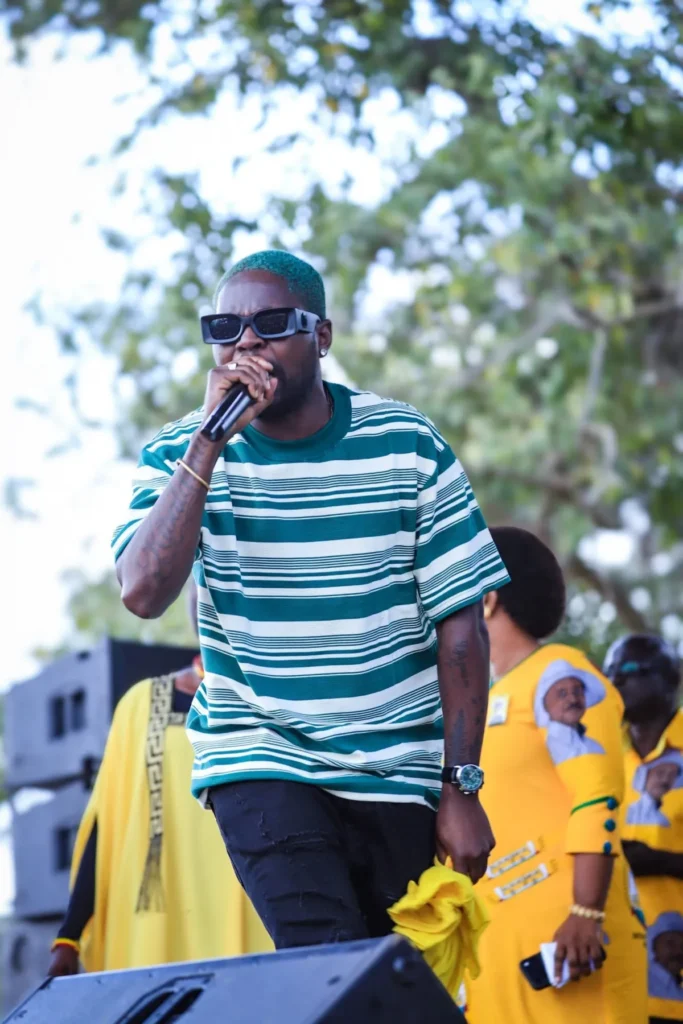
His core argument was straightforward but serious: an artist’s personal reassurance, however well-intentioned, does not override the contractual and legal reality of a label’s ownership over music rights. If Swangz Avenue has not issued a formal statement endorsing Azawi’s position, then businesses and individuals relying on her word alone could find themselves in very uncomfortable territory.
But that’s not even the wildest part — because Green Daddy then delivered the line that sent the clip viral before the show had even ended.

“They will arrest you people.”
Not a suggestion. Not a maybe. A warning.
Azawi — full name Patricia Azawi — is arguably Uganda’s most internationally recognised female artist of her generation. Signed to Swangz Avenue, the Kampala-based powerhouse label that has launched some of East Africa’s biggest careers, she has built a catalogue of Afrobeats and Afropop hits that command airplay far beyond Uganda’s borders.
Swangz Avenue is not a passive management outfit. It is a full-scale music business with its own recording studio, artist development programme, and commercial interests — meaning questions about music rights and licensing are not minor administrative details. They are core business.
Green Daddy is a veteran of Uganda’s music and entertainment industry, known for speaking with the kind of institutional knowledge that comes from years of navigating the business side of the creative world. His intervention is not that of a critic looking for a target — it is that of someone who understands exactly how music contracts work and why the distinction between an artist’s personal statement and a label’s official position matters enormously.
Uganda’s new copyright law has placed every artist, label, and commercial establishment at a pivotal crossroads — and the Azawi situation has become its first major test case.
Fans immediately split into two loud camps the moment Green Daddy’s clip began circulating — and neither side was whispering.
Team Azawi flooded comment sections defending her gesture as an act of love for her audience, arguing that Green Daddy was being unnecessarily legalistic about what was clearly a heartfelt message.
Team Green Daddy countered that love doesn’t hold up in court, and that a nightclub owner relying on Azawi’s Instagram reassurance as legal cover for unpaid licensing fees was going to have a very bad day.

The internet had thoughts, and they were absolutely not holding back.
“They will arrest you people” became the clip of the moment — screenshot, reposted, and remixed into memes across every major platform within hours. The line had the energy of a prophecy and the delivery of a disappointed uncle who had seen this exact situation before.
Some fans believe Azawi’s statement, while legally complicated, reflects a genuinely important philosophical position — that artists should have the autonomy to determine how their music reaches their audiences, regardless of the commercial framework around them.
Others argue that Green Daddy has identified a real tension at the heart of Uganda’s copyright conversation: the gap between what artists feel and what labels control — a gap that the new law has suddenly made very expensive to misunderstand.
Sources close to Uganda’s music business community have noted that Swangz Avenue’s silence on the matter is itself significant. Whether that silence represents quiet disagreement with Azawi’s statement, a considered legal strategy, or simply a PR decision not to engage, it’s unclear — but every hour without an official response adds weight to Green Daddy’s original question.
It’s unclear whether Azawi will walk back her statement, clarify it, or double down. But Swangz Avenue’s next move — or continued silence — will tell the whole story.
There is something genuinely poignant about the position Azawi finds herself in.
She made a statement that came from a place of generosity — a desire to keep her music accessible to the Ugandan public that made her who she is. That impulse is not wrong. It is, in many ways, beautiful.
But the music industry is a structure, and structures have rules. And when an artist is signed to a label, their generosity operates within limits they may not fully control — limits that exist precisely because the business of music is complicated enough to require lawyers, contracts, and licensing agreements.

Green Daddy’s intervention, beneath the sharp delivery, is ultimately a protective one. He is not trying to embarrass Azawi. He is trying to stop ordinary Ugandans from making expensive decisions based on incomplete information.
Sometimes the most caring thing someone can say is: wait — let’s check the small print first.
Here is the quiet irony at the centre of this entire situation: Uganda spent years fighting for a copyright law to protect its artists — and the first major controversy under that law is an artist potentially giving away protections the law was designed to secure.
The system finally arrived to protect the creators.
And one of the creators told everyone not to worry about the system.
Swangz Avenue, whenever you’re ready — Uganda is listening.
Azawi’s heart was clearly in the right place. But in the music business, hearts don’t sign contracts — labels do.
The real question now is: will Swangz Avenue back her up, correct the record, or stay silent long enough to let Green Daddy’s warning age into prophecy? 👀