

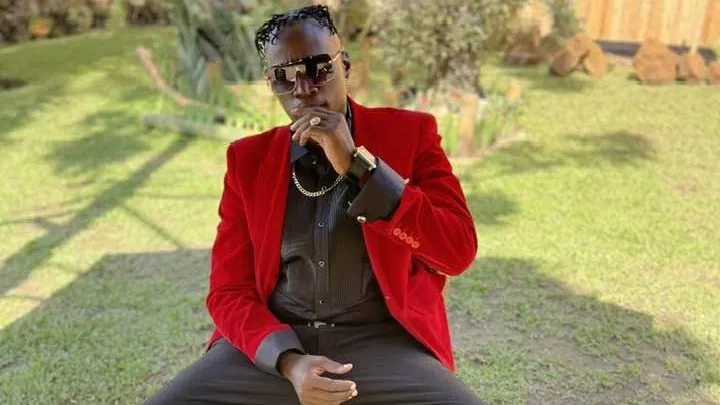
There is a Ugandan artist who stood on the stage at the launch of MTV Base Africa — one of the most significant moments in the history of African music television — alongside 2Baba, one of the continent’s most celebrated entertainers. He came home. And Uganda, for the most part, kept talking about someone else.
That artist is Peter Miles. And after years of carrying that particular weight quietly, he has decided to talk about it.
The veteran dancehall singer opened up about a career that took him to genuinely historic moments on the continental stage while the recognition he deserved at home went largely to other names. What he said is not bitter. It is not a takedown. It is simply the account of a man who did significant things and watched the credit land somewhere else — and who has spent enough time sitting with that reality to finally speak about it plainly.
And the concert situation? That is not even the most surprising part of what he revealed.
Peter Miles did not ease into the MTV Base Africa story. He stated it as fact because it is fact.
“Me and 2 Face Idibia launched MTV Base Africa, it was the biggest music TV.”

For anyone who needs the weight of that sentence to land properly — MTV Base Africa was not a minor regional cable channel. It was a transformational moment for how African music was distributed, consumed, and recognised globally. The names on that launch stage were there because they represented something significant about where African music was going.
Peter Miles was one of those names. He was there as Uganda’s representative in a moment that mattered to the entire continent.
He came home to find the conversation had moved on without him. At the height of his rise, he says, Ugandans were largely focused on the profiles of Jose Chameleone and Bebe Cool — two artists whose careers were unquestionably significant, but whose visibility at home apparently left little room for the recognition Peter Miles felt his own contributions had earned.
His goal, he explained, was never personal fame for its own sake. He wanted to raise Uganda’s profile on the global stage through dancehall music — to make the country’s name mean something in rooms he was actually entering. That the country did not fully register what he was doing in those rooms is the quiet frustration underneath everything he said.

Peter Miles is a veteran of Uganda’s dancehall scene whose career placed him in spaces that most local artists of his era never reached. His connection to the African music landscape was not aspirational — it was operational. He was there, doing the work, building the relationships, representing the flag.
Dancehall music in Uganda has a history that runs deeper than many casual listeners acknowledge, and Peter Miles sits near the roots of that history. His catalogue includes songs that connected with audiences and demonstrated that Ugandan artists could operate meaningfully within a genre that was largely dominated by Jamaican and West Indian sounds.

The comparison to Chameleone and Bebe Cool is not an attack on either artist. It is an observation about how attention works — and how it is possible for a country to celebrate some of its ambassadors loudly while barely registering others who were doing equally consequential work in different spaces.
Fans immediately responded to the MTV Base Africa revelation with a mixture of genuine surprise and retrospective guilt — and the internet had thoughts, and they were not holding back.
Many followers admitted they had simply not known. The launch of MTV Base Africa is documented history, and Peter Miles’ presence on that stage is verifiable — but for a generation of Ugandan music fans who came of age consuming that channel without knowing the story behind its launch, the revelation hit differently.
Comment sections filled with people doing quick searches, pulling up references, and coming back with reactions that ranged from embarrassment to renewed appreciation. The phrase “we didn’t know” appeared repeatedly — which, depending on how you read it, is either an explanation or a confession.
Some fans believe Peter Miles is part of a wider pattern in Uganda’s music history — artists who did significant international work during an era when social media did not exist to document and amplify every milestone in real time. Without the digital infrastructure that today’s artists use to make every achievement visible instantly, careers like his relied on word of mouth and media coverage that did not always materialise in proportion to the work being done.
Others are pointing to the Chameleone and Bebe Cool comparison as evidence of how scarcity of attention works in small markets — when the spotlight is limited, it tends to concentrate rather than distribute, and artists outside the brightest circle can spend entire careers in a shadow that has nothing to do with the quality of their output.

It’s unclear whether Peter Miles has received any formal recognition from Uganda’s music industry or government institutions for his contributions. Sources close to the veteran music community suggest he is far from alone in feeling overlooked — but he may be among the first to say it this directly.
The concert question produced an answer that was equal parts principled and illuminating. Peter Miles has a catalogue of hit songs. He has the profile. He has the history. The logical question is why he has never converted any of that into a major headline concert.
His answer was unambiguous.
“I would need a whole year of rehearsing, with my own production because I know the songs I did and the instruments and those are the same ones I want during the live performance.”
He elaborated further — he does not believe in doing things half baked. Any concert he stages must meet the standard he envisions for his fans. A year of rehearsal. Live instrumentation matching the original recordings. Full production built to his specification.
That is not an excuse for inaction. That is a creative philosophy. And coming from an artist who launched a continent-defining music television platform alongside one of Nigeria’s greatest ever performers, it is a philosophy that deserves to be taken at face value rather than read as avoidance.

Peter Miles is saying he will do it properly or not at all. Given everything he has described about his career standards, that position is completely consistent.
Here is what sits underneath all of this. A man spent years representing Uganda in spaces the country never fully acknowledged, held himself to standards that kept him from the shortcuts others took, and is now talking about it openly — not to tear anything down but to make sure the record reflects what actually happened.
That is not bitterness. That is documentation. And Uganda’s music history is richer, more accurate, and more honest for him having said it out loud.
Here is the sentence that Uganda needs to sit with this week: Peter Miles was on the MTV Base Africa launch stage with 2Baba while Uganda was busy making other people famous. The continent knew. The home crowd missed it entirely.
History has a way of correcting these things — but only if someone is willing to speak up and remind people what they overlooked.
Peter Miles launched MTV Base Africa. He has a catalogue built on real craft and continental ambition. And when he finally stages that concert — after a full year of rehearsals with live instrumentation matching every original recording — it will be worth every minute of the wait.
The question is not whether Peter Miles deserved more recognition. The evidence suggests he did. The real question is whether Uganda is finally ready to give it to him — or whether it will take another twenty years and another interview for the country to realise what it had. What do you think Uganda owes its overlooked pioneers?