

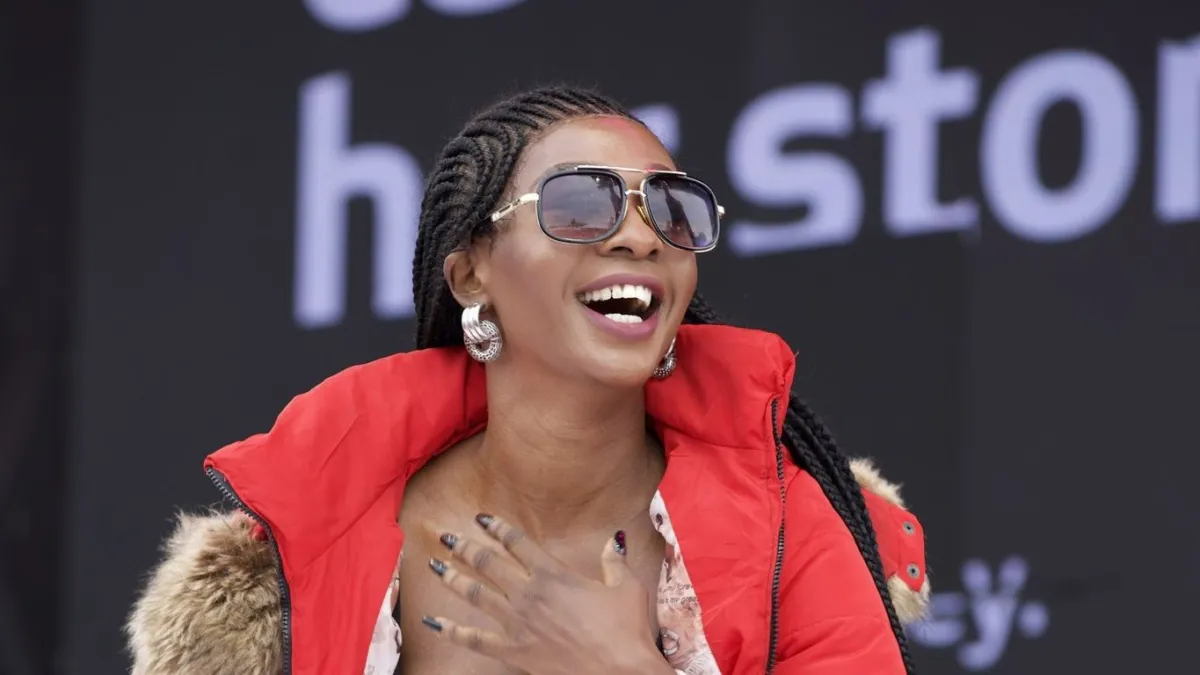
Cindy Sanyu has never been short of ambition. What she says she has been short of is government support — and she is making the case that one cannot exist without the other.
In a recent interview, the self-styled King Herself laid out a detailed and pointed argument for why Uganda’s artists have struggled to break onto the international stage, using Diamond Platnumz’s rise as her primary reference point. Her conclusion is not flattering for the Ugandan government — but it is hard to dismiss.
Cindy’s argument begins in Tanzania.
Before Diamond Platnumz became one of Africa’s most globally recognised artists, she argues, Tanzania had no significant presence on the international music circuit. What changed, according to Cindy, was not just Diamond’s talent — it was deliberate, state-level investment.
In her own words: “Before Diamond Platnumz, nobody in Tanzania was going international. He got international attention because the government got involved. The (Tanzanian) president actually funded his career with the aim of selling the country through him as an artist. That’s how he got that collaboration with Davido, and they started to put him in places he had to be.”

She then turned the lens on Uganda.
“Our government doesn’t care.”
Four words that carry the weight of an entire career’s worth of frustration.
Cindy went further, explaining how the economics of international media exposure work — and why Uganda’s artists keep getting left out of the equation.
“MTV does not get any value from playing Cindy because my country does not have any ADs on MTV. There is no actual need to play Cindy, but they have to play Davido because they have ADs and money they are getting from Nigeria.”

It is a candid and remarkably clear-eyed assessment of how the global music industry actually operates. Talent, she is saying, is only part of the equation. Money, media buying, and government-backed cultural diplomacy do the rest.
Without that infrastructure behind her, Cindy says her dream of performing on the global stage remains real but layered with obstacles that no individual artist can resolve alone.
“I have always had plans of playing on the global stage, but it has layers to it that, as Ugandans, we need to sit and talk about.”
Cindy Sanyu is one of the most decorated and enduring figures in Ugandan music. Her career spans well over a decade of consistent output, major awards, and a fanbase that has remained loyal through multiple shifts in the industry’s landscape. The title she gave herself — King Herself — was never just a branding exercise. It reflected a deliberate claim on a space in Ugandan entertainment that she has held and defended.
Her comments about government support are not new as a general conversation in African music circles, but hearing them from someone of her standing, with this level of specificity, gives the argument added weight.


Diamond Platnumz, for his part, has become the most cited example of what African government-backed cultural diplomacy can look like in practice — a template that several other countries on the continent have begun studying and, in some cases, replicating.
Cindy is not simply venting. She is describing a structural problem with structural consequences.
When governments treat their artists as cultural ambassadors and invest accordingly, the returns extend beyond music — they include tourism, soft power, international perception, and economic activity. Nigeria understands this. Tanzania has demonstrated it. Uganda, Cindy argues, has not yet made that calculation in a meaningful way.
For younger Ugandan artists watching this conversation unfold, her words carry an implicit message: the ceiling they keep hitting may not be about talent. It may be about policy — and that is a problem no amount of hard work alone can solve.
Alongside the broader industry argument, Cindy also offered a quieter, more personal reflection on where she currently stands in her own career.

She is not chasing hits. She is not trying to rebuild or reinvent. She is in a phase she describes with unusual honesty — one focused on sustaining a relationship with the audience she has already earned.
“At the moment, I don’t need a hit song. But I need to float, I can’t sink, I need really good music that doesn’t necessarily need that much promotion. It doesn’t have to be so popular, but something they can remember me by to walk through with my established fanbase. I need to give them something as we keep walking together.”
There is something quietly powerful about a major artist saying that out loud — acknowledging the shift from conquest to continuity, and being at peace with it.
Cindy Sanyu has built one of Uganda’s most respected careers largely on her own terms. What she is asking for now is not a handout — it is a seat at a table that other governments have already set for their artists.
The question is whether Uganda is listening.