

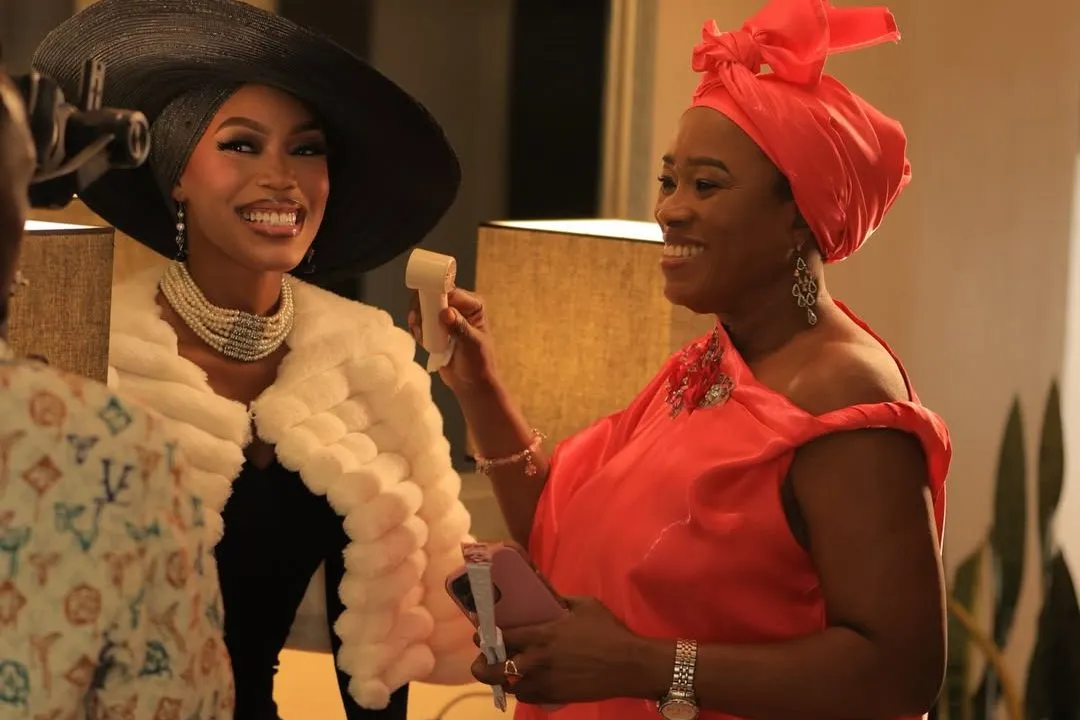
Six hundred million shillings. That’s roughly what it would cost — in cattle alone — to marry Rachel Kiwanuka.
No ring. No venue deposit. No catering budget. Just 300 cows, standing in a field, before the conversation even starts.
Uganda’s beloved veteran musician Halima Namakula has once again gone on record with the most talked-about bride price demand in the country right now — and this time, it was Hon. Balaam Barugahara Ateenyi’s offhand joke at a public function that brought the number back into the spotlight. Halima didn’t blink. She repeated the figure with the calm confidence of a woman who has already done the math.
Three hundred cows. Approximately UGX 2 million each. You do the rest.
The moment unfolded at a function celebrating Rachel Kiwanuka’s return from Hajj, where Hon. Balaam — never one to miss a room — jokingly hinted at wanting a private word with Rachel K.
Halima’s response was immediate, unbothered, and deeply mathematical.

“I said I want 300 cows as dowry from the man willing to take my daughter Rachel K’s hand in marriage,” she stated, leaving absolutely zero room for negotiation or misinterpretation.
Balaam, to his credit, didn’t flinch either. He clarified that this was not breaking news — Halima had set this requirement a long time ago and had been consistent about it. “She wants a man marrying her daughter to come like a Sudanese Dinka,” he explained, referencing the famous cattle-rich bride price traditions of South Sudan’s Dinka people.
And then things got really interesting.
When you break the numbers down, the figure isn’t just symbolic — it’s staggering. At roughly UGX 2 million per cow, 300 head of cattle translates to approximately UGX 600 million. That’s before anyone asks about goats, bark cloth, suitcases, or the function itself.
For context: that amount could buy a comfortable house in Kampala’s suburbs. Multiple times.
Halima, apparently, is aware of this. And she does not seem troubled by it.


Halima Namakula is not simply Rachel Kiwanuka’s mother — she is one of Uganda’s most celebrated veteran musicians, whose career spans decades of Luganda music that has become part of the country’s cultural fabric. Her name carries weight in Ugandan entertainment circles, and her opinions tend to land with authority.
Rachel Kiwanuka, known widely as Rachel K, has carved her own space in Ugandan music and public life — and her mother’s very public attachment to her future is clearly not a recent development. Balaam’s confirmation that the 300-cow declaration has been in circulation for years suggests this isn’t a dramatic reaction to a specific suitor. It’s a standing policy.
Hon. Balaam Barugahara Ateenyi, meanwhile, is one of Uganda’s most colourful public figures — a businessman, politician, and entertainment industry fixture whose presence at any function tends to generate at least one memorable moment. This occasion was no exception.
The moment the 300-cow figure resurfaced online, the reaction was instant and merciless — in the best possible way.
Fans immediately noticed the very specific cultural reference Balaam dropped: “come like a Sudanese Dinka.” The Dinka people are globally known for their elaborate cattle-based bride price traditions, where the number of cows offered reflects the groom’s family’s seriousness and the bride’s perceived value. Halima invoking that standard for her Ugandan daughter was the kind of cross-cultural flex that the internet simply was not prepared for.
Within hours, the quote was being shared across X, WhatsApp groups, and Facebook pages with the kind of energy that only truly unhinged bride price numbers generate.

The internet had thoughts, and they were not holding back.
Reactions split almost immediately along predictable lines — though with far more laughter than outrage.
Some fans celebrated Halima’s declaration as a mother simply placing the highest possible value on her child, in the tradition of a culture where bride price has always carried symbolic weight beyond its monetary figure. “She’s not selling her daughter — she’s communicating what her daughter is worth,” one widely-shared comment read.
Others, predictably, questioned the practicality. Some pointed out that even Uganda’s most financially comfortable families would struggle to mobilise 300 cows on short notice — or at all. A few wondered, only half-jokingly, whether a payment plan was available.
It’s unclear whether Halima intends the figure literally or whether — as many suspect — the number is a deliberate conversation-stopper designed to ensure only truly serious suitors come knocking. Either way, it’s working as a filter.
Strip away the jokes and the staggering cattle arithmetic, and what Halima Namakula is really expressing is something most parents understand completely.
No number is ever really high enough when it comes to the person you raised. The 300 cows aren’t purely transactional — they’re a statement about love, sacrifice, and the weight of what it means to hand your child’s future to someone else. In Ugandan culture, bride price has always been as much about respect and relationship as it has been about livestock.
Halima has spent decades building a career and a family in the public eye. That she’s unapologetic about how highly she values what she’s built — including her daughter — is perhaps the least surprising thing about this story.
Here’s the most quietly hilarious part of all of this: Balaam Barugahara — one of Uganda’s most resourceful and well-connected men — made a joke about talking to Rachel K privately.
And Halima Namakula responded with 300 cows.
Nobody pushed back. Nobody laughed it off. The number just sat there, in the room, doing exactly what 300 cows are supposed to do.
Halima Namakula has set the standard, the price, and the cultural reference point — all in one sentence.
So, gentlemen: do you have 300 cows? And if not, are you even in the conversation? Drop your honest answer below — this one deserves a comment section.