

By Wamala Sipirian
Published: September 17, 2026
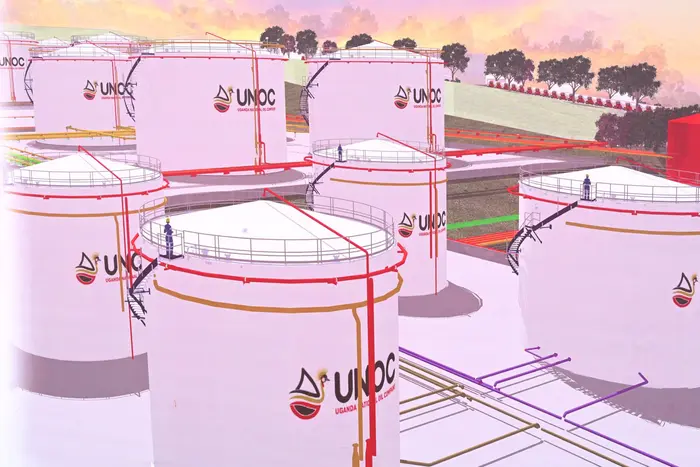
President Yoweri Museveni has presided over the groundbreaking of the Kampala Storage Terminal (KST) in Mpigi District, a major petroleum infrastructure project designed to strengthen Uganda’s fuel security.
The terminal, being developed by the Uganda National Oil Company (UNOC), will have a storage capacity of 320 million litres of petroleum products.
Uganda currently consumes about 240 million litres of petroleum products each month, according to information presented at the ceremony.
Energy and Mineral Development Minister Monica Musenero said the project would help protect Uganda against disruptions in international fuel supplies, market shocks and emergencies.

“It will secure our energy security as a nation. It is going to be a strategic positioning project for the country,” Musenero said.
Uganda to Increase Strategic Fuel Storage
The government currently holds about 30 million litres of fuel at its Jinja storage terminal, with work underway to add another 10 million litres.
Once the Mpigi and Jinja facilities are completed, Uganda’s combined storage capacity will reach 360 million litres.
Musenero said the government acquired land for the Mpigi facility in 2008, as demand for petroleum products continued to increase.
The Kampala Storage Terminal is also part of a petroleum infrastructure plan developed in 2017.
Under the plan, the facility is expected to serve as a delivery point for the proposed Eldoret-Kampala petroleum pipeline extension.

It is also intended to support the proposed Kampala-Kigali pipeline and the Hoima-Buloba pipeline, which would transport petroleum products from Uganda’s planned refinery in Hoima to the new storage facility.
Construction of the Hoima refinery is expected to begin next year, according to the source material.
Terminal to Support Fuel Reserves and UNOC Trading
The new facility will provide UNOC with additional space to manage its petroleum trading stock while allowing the government to establish and maintain strategic fuel reserves.
“It will give us a buffer against international supply disruptions, market shocks and other emergencies,” Musenero said.
The additional storage capacity is intended to reduce Uganda’s vulnerability to interruptions in international fuel supply.
Museveni Says Storage Capacity Remains Inadequate
While welcoming the project, Museveni said the planned 320 million-litre capacity was still insufficient for Uganda’s long-term energy security needs.

He criticised what he described as delays in addressing weaknesses in the country’s petroleum supply system.
“Sleeping has been a big problem in Africa. In this sector, there was a lot of sleeping,” Museveni said.
The president recalled that Uganda previously relied on middlemen in Kenya to purchase petroleum products before the government changed its import arrangements.
Museveni said he raised concerns with then Energy Minister Irene Muloni after learning about the arrangement and later worked with government officials to establish direct links with refineries.
Uganda subsequently changed its import system to allow UNOC to purchase petroleum products directly and supply local oil marketing companies.
Museveni said the country was gradually addressing weaknesses in its petroleum supply chain but needed substantially larger reserves.

“We are now moving slowly out of sleep,” he said.
He pointed to Uganda’s monthly consumption of about 240 million litres and the relatively small storage capacity at Jinja.
“You have heard that in a month we use 240 million litres of petroleum, but up to now, the storage in Jinja was only 30 million,” Museveni said.
The president said the new Mpigi terminal would provide more than one month’s supply based on current consumption levels but argued that the capacity would still not be sufficient if Uganda faced prolonged disruptions.
“This one here will be 320 million litres, which should secure us for a month plus. People are happy, but I see that this is not how a country should be run,” Museveni said.
“I think this here is not enough.”
Sources
Pulse Uganda