

By Wamala Sipirian
Published: September 24, 2026
KAABONG — A sorghum variety developed by the National Agricultural Research Organisation (NARO) is showing potential to help farmers in drought-affected Karamoja maintain food production despite increasingly difficult climatic conditions.
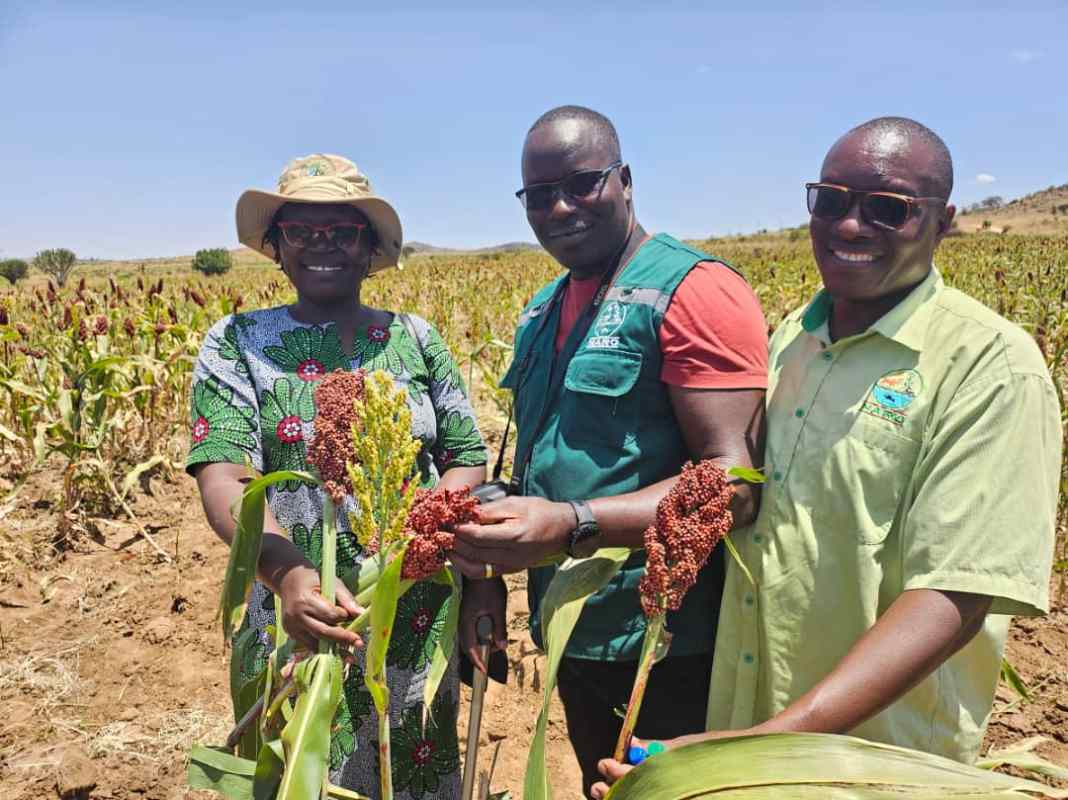
NARO Sorghum 2, commonly known as NAROSORG2, was developed to withstand harsh climatic conditions and has performed well in demonstration gardens established across the Karamoja sub-region.
One of the demonstration sites is a five-acre farm in Katile Sub County, Kaabong District, where farmers recently gathered for a field day to assess the crop’s performance.
Drought-Tolerant and Early Maturing
Dr Walter Odongo, Director of Research at NARO’s Nabuin Zonal Agricultural Research and Development Institute (ZARDI), said NAROSORG2 has several characteristics that make it suitable for Karamoja’s conditions.
“It is early maturing, it is drought tolerant, it can withstand extreme drought and still give you some good degree of yield,” Odongo said.

According to Dr Ijara Anthony Raphael, a Senior Research Officer at NARO, the variety takes about 80 days from planting to maturity under conditions in Karamoja.
The shorter maturity period could allow farmers to harvest food sooner and potentially create opportunities for additional planting within a year.
NAROSORG2 also addresses a production challenge faced by sorghum farmers in the region: damage caused by birds.
“The third strong attribute about this sorghum variety, and which excites the farmers most, is that this variety of sorghum is not eaten by birds, which are a very common production constraint within the region,” Odongo said.
Demonstration Gardens Across Karamoja
The Katile demonstration is part of NARO’s efforts to promote agricultural technologies adapted to the semi-arid conditions of Karamoja.
The organisation established parish-level demonstration gardens across the six districts of Karamoja, with the sites measuring between five and 10 acres.
The gardens are intended to give farmers an opportunity to observe different technologies and agricultural practices under local conditions, including planting dates and crop management approaches.

The Katile demonstration was established in collaboration with Kaabong District agricultural extension staff, with farmers participating from land preparation and planting through crop management and harvesting.
“It has been important to showcase to the farmers that it is possible with improved technology from NARO for production to be done in the dry agroecologies,” Odongo said.
Ijara said the demonstrations are intended to help farmers identify technologies that can improve food security and household incomes as the region faces recurring drought.
“Karamoja is challenged by hitting droughts. Our minds are triggered at getting technologies which can ensure food security and income for the Karamoja people,” he said.
The demonstrations are also expected to provide a pathway for farmers to access seed and eventually multiply the technology within their communities.
Drought Deepens Food Insecurity
The initiative comes as drought continues to affect communities in Karamoja, with thousands of families facing food insecurity.
Kaabong District LCV Chairman Lotyang Albert Loris said the impact of the drought on communities has been severe.

“There is no doubt that our people are suffering. They have no food. And it is not because of laziness, but the weather conditions can be so harsh,” Loris said.
Loris welcomed the introduction of NAROSORG2, particularly its shorter maturity period.
“Looking at the fast maturity of this crop, people would even be able to introduce a second harvest season in a year. This is phenomenal,” he said.
NARO Supports Seed Multiplication
Dr Damalie Akwango, Coordinator of the Uganda Climate-Smart Agriculture Transformation Project (UCSATP) at NARO, said the intervention in Karamoja includes more than demonstrating drought-adapted crop varieties.
NARO is also supporting seed multiplication to improve farmers’ access to planting materials for crops including sorghum and cassava.
“Under the project, we are promoting early maturing varieties to try to reduce food insecurity in this region and also improve their household income,” Akwango said.
The approach is aimed at helping farmers move beyond simply coping with drought and instead adopt agricultural technologies and practices that can support production during climatic shocks.

Farmers Welcome the Variety
Miriam Akitwi, an extension worker involved in the demonstration, said farmers had participated throughout the crop’s development on the demonstration farm.
“We have worked on this demonstration farm together with the farmers right from the time of land opening up to the level where we are able to see this good yield that is ready for harvest,” she said.
Akitwi said farmers were encouraged by the crop’s performance despite the difficult weather conditions.
“They are appreciating NARO SORG 2 as a rare variety,” she added.
Local farmer Apui John Baptist said the difference between NAROSORG2 and sorghum varieties traditionally grown in the area was already becoming visible.
“This is a good variety which can manage the conditions in Karamoja better than the one we have been growing,” he said.
Apui said the crop matures faster and can withstand the strong sunshine experienced in the region.
“My message to the Government and NARO is that we are happy. As a farmer, I’m happy to the team for having brought this type of sorghum to us,” he said.
The next objective is to enable farmers to take the seed and knowledge gained from the demonstration plots back to their communities and expand production across Karamoja.